
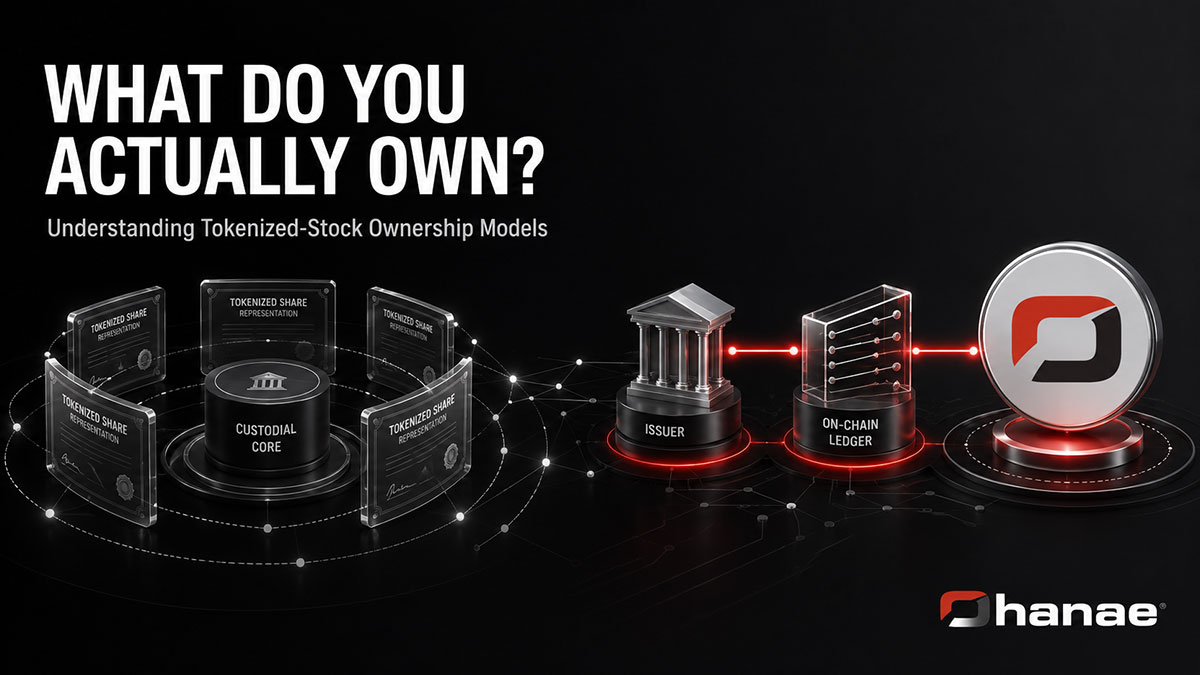
What Do You Actually Own? Understanding Tokenized-Stock Ownership Models
A comparison of third-party-backed tokens, issuer-sponsored shares and blockchain-native securities infrastructure
“Tokenized stock” has become one of the most widely used—and potentially misunderstood—terms in digital finance.
Coinbase, Kraken, Binance, OKX and other global platforms are bringing U.S. equities onto blockchain networks. These products can provide 24-hour trading, fractional access, wallet-based transfers and integration with decentralized-finance applications.
But tokenization describes the technology. It does not, by itself, tell an investor what they legally own.
A token may represent:
- An issuer-authorized share recorded through the issuer’s ownership system;
- A beneficial interest or contractual claim relating to shares held by a third party;
- A security entitlement supported by assets held in custody; or
- Synthetic exposure that follows the price of a security without conveying ownership of it.
These arrangements can have materially different consequences for voting, dividends, redemption, custody, counterparty exposure and insolvency protection.
The essential question is therefore not simply:
Is this stock tokenized?
It is:
What does the token legally represent, who recognizes the investor’s ownership, and where is that ownership recorded?
The SEC’s ownership-model distinction
In January 2026, the staff of the Securities and Exchange Commission published a Statement on Tokenized Securities.
The statement distinguishes between two principal categories:
- Securities tokenized by or on behalf of the issuer; and
- Securities tokenized by an unaffiliated third party.
This distinction matters.
When an operating company authorizes a tokenized share class, the blockchain can form part of the system used by the issuer or its transfer agent to maintain the securityholder record. A transfer of the token can therefore result in a recognized transfer of the security within the issuer’s official ownership infrastructure.
A third-party provider can instead purchase or custody shares and issue a separate token representing an interest, entitlement or contractual claim relating to those shares. The investor owns the tokenized instrument under the third party’s legal structure—not necessarily a share issued or recognized directly by the operating company.
Both models can provide useful access and economic exposure. But they are not legally or operationally identical.
The platform descriptions below are based on publicly available information as of August 30, 2026. Product structures, rights and geographic availability may change.
Coinbase: a regulated third-party structure
Coinbase has introduced tokenized U.S. equities for eligible investors outside the United States through an Abu Dhabi-based structure.
According to Coinbase, each token initially represents a beneficial interest or senior claim relating to an underlying share held in segregated custody. The underlying shares and associated property are held through a Coinbase-affiliated special-purpose structure.
Coinbase describes each token as 1:1 backed and as providing a beneficial claim and direct economic exposure to an underlying share. Voting, redemption, dividends and other rights remain governed by the applicable prospectus and holder eligibility.
The operating companies whose shares are referenced—such as Apple, NVIDIA, Meta or Alphabet—did not issue these tokens. Coinbase and its affiliated structure created the tokenized instruments.
Coinbase’s model is nevertheless strategically significant. It combines:
- A major global distribution platform;
- Regulated custody;
- Tokens issued on Base;
- Continuous market-data feeds;
- Wallet-based access; and
- Potential integration with lending, trading and other decentralized-finance applications.
The result is a highly scalable distribution and on-chain utility model—but one in which the tokenholder’s rights originate through the third-party structure rather than directly from the operating-company issuer.
Learn more about Coinbase Tokenized Stocks.
Kraken and xStocks: tokenized representations distributed globally
Kraken distributes xStocks, which are tokenized representations of U.S. stocks and exchange-traded funds issued through a third-party framework.
Each xStock is described as being backed 1:1 by an underlying security held through regulated custody. The tokens can be transferred across supported blockchain networks and, subject to applicable terms, redeemed for cash value or the underlying asset.
The investor does not acquire a token issued by Apple, Tesla, NVIDIA or another referenced company. The investor acquires an xStock created under the third-party issuer’s legal structure.
Kraken’s principal role is distribution. It provides investors with a familiar trading interface, account access, liquidity and the ability to move supported tokens into compatible wallets.
This illustrates an important division of responsibilities:
- The third-party issuer creates the tokenized instrument;
- A custodian holds the supporting shares;
- Kraken provides distribution and trading access; and
- Blockchain networks provide transferability and programmability.
Learn more about xStocks on Kraken.
Binance and bStocks: 1:1 backing within a broader digital-asset ecosystem
Binance offers bStocks, described as tokenized securities backed 1:1 by U.S. shares held through regulated custody.
As with other third-party-sponsored structures, 1:1 backing does not automatically mean that the investor appears as the registered owner on the operating company’s shareholder records. The investor’s rights depend on the bStock’s legal documentation, custody arrangements and corporate-action procedures.
Binance’s competitive advantage comes from its distribution ecosystem. It can place tokenized equities alongside cryptocurrencies, stablecoins and other digital assets while connecting them with trading, collateral and wallet-based services.
This model demonstrates how exchanges can rapidly introduce economic exposure to many existing public companies without requiring each company to create a new blockchain-native share class.
Learn more about bStocks on Binance.
OKX: aggregating third-party tokens and liquidity
OKX has taken a different approach through Unified Tokenized Stocks.
Rather than issuing the securities itself, OKX supports tokens created by one or more third-party issuers. Its structure is designed to bring different tokenization providers together through unified tickers, order books and liquidity.
OKX therefore acts primarily as a distribution and trading layer.
Its terms expressly state that the underlying tokens are issued by third-party providers. The investor’s legal rights ultimately depend on the terms of the applicable issuer—not merely on the fact that the product trades through OKX.
This aggregation model addresses a practical market problem: multiple providers may issue different tokenized versions of the same underlying stock, fragmenting trading volume and liquidity. A unified market can make the customer experience simpler even though the underlying legal structures remain separate.
Review OKX’s Unified Tokenized Stock terms.
Ohanae: issuer-sponsored blockchain-native securities
Ohanae is pursuing a different segment of the market.
Rather than creating third-party representations of established public equities, Ohanae is building regulated market infrastructure through which an operating company can authorize and issue its own blockchain-native security.
Under this model:
- The operating company authorizes the issuance of a blockchain-native security designed for secondary trading outside the traditional National Market System (“NMS”);
- The security is offered and sold pursuant to an effective registration statement or an applicable exemption from registration;
- Ohanae, Inc., an SEC-registered transfer agent, maintains the issuer’s securityholder records;
- The blockchain record forms part of the ownership and transfer-agent infrastructure;
- Ohanae Securities LLC, a FINRA-member broker-dealer, provides regulated custody, carrying, clearing and settlement;
- Eligible investors, including investors outside the United States where permitted, may access the platform subject to applicable offering, investor-qualification and jurisdictional restrictions, completion of KYC/AML verification, and connection of a supported bank account;
- Secondary transactions can be supported through a dealer-principal model; and
- Securities and OUSD, Ohanae’s internal settlement token, can settle atomically within the platform.
The investor-registration treatment depends on the applicable account and custody structure. The central distinction is that the security itself is authorized by the operating-company issuer and integrated with its official ownership and transfer-agent system.
Ohanae is therefore not simply placing an existing security inside a digital wrapper. It is building the market infrastructure for securities designed from issuance to operate on blockchain rails.
Five questions investors and issuers should ask
Before evaluating any tokenized-stock product, market participants should ask:
1. Did the operating company authorize the token?
If not, the token is generally a third-party-sponsored instrument, even when fully backed by underlying shares.
2. What does the investor legally own?
The investor might own an issuer-authorized security, a security entitlement, a beneficial interest, a debt claim, a contractual redemption right or synthetic exposure.
3. Where is ownership officially recorded?
Blockchain records may constitute part of the issuer’s master securityholder file—or they may record ownership of a separate instrument created by a third party.
4. Who holds the underlying shares?
When a token is backed by existing shares, investors should understand the roles of the issuer, special-purpose vehicle, broker, custodian and trustee.
5. Who administers shareholder rights?
Voting, dividends, stock splits, tender offers, redemptions and other corporate actions may be administered by the operating-company issuer and its transfer agent or passed through a third-party structure under separate contractual terms.
Different models can serve different markets
Third-party-backed tokens can expand international access to established U.S. public equities. They can also provide wallet portability, round-the-clock trading and integration with digital-asset applications.
Issuer-sponsored securities serve a different purpose. They allow companies to create blockchain-native ownership, capital-formation and liquidity structures from the beginning.
These models do not need to be mutually exclusive.
Global exchanges can contribute customer reach, product discovery, wallet connectivity and distribution. Broker-dealers can provide regulated customer access and securities-market protections. Transfer agents can maintain the official ownership record. Institutional liquidity providers can support reliable secondary-market liquidity. Issuers can design securities appropriate for blockchain-native markets.
This complementary architecture is the foundation of the Ohanae Consortium.
Under such a model, an exchange could refer eligible investors to Ohanae while maintaining permanent source attribution. Investors would establish regulated accounts with Ohanae, and Ohanae would provide the underlying securities infrastructure—including custody, carrying, clearing, settlement, transfer agency and issuer-sponsored secondary-market support.
Tokenization is only the beginning
The next phase of tokenized securities will not be defined merely by placing more assets on blockchain networks.
It will be defined by the legal and operational infrastructure connecting:
- The issuer;
- The investor;
- The ownership record;
- The custodian;
- The broker-dealer;
- The liquidity provider;
- The settlement asset; and
- The distribution platform.
Coinbase, Kraken, Binance and OKX demonstrate the global demand for accessible, programmable and continuously available equity products.
Ohanae addresses the next question:
What would the market look like if the security itself—not merely a third-party representation—were designed for blockchain-native issuance, ownership, trading, liquidity, clearing and settlement?
That is the market infrastructure Ohanae is building.
NYSE. Nasdaq. Now, Ohanae.
Regulated market infrastructure for blockchain-native securities markets.
This article is provided for general informational purposes only and does not constitute legal, investment or securities advice. Product structures, investor rights and geographic availability may change. Readers should review the applicable offering documents, prospectuses and platform terms before making any investment decision.