
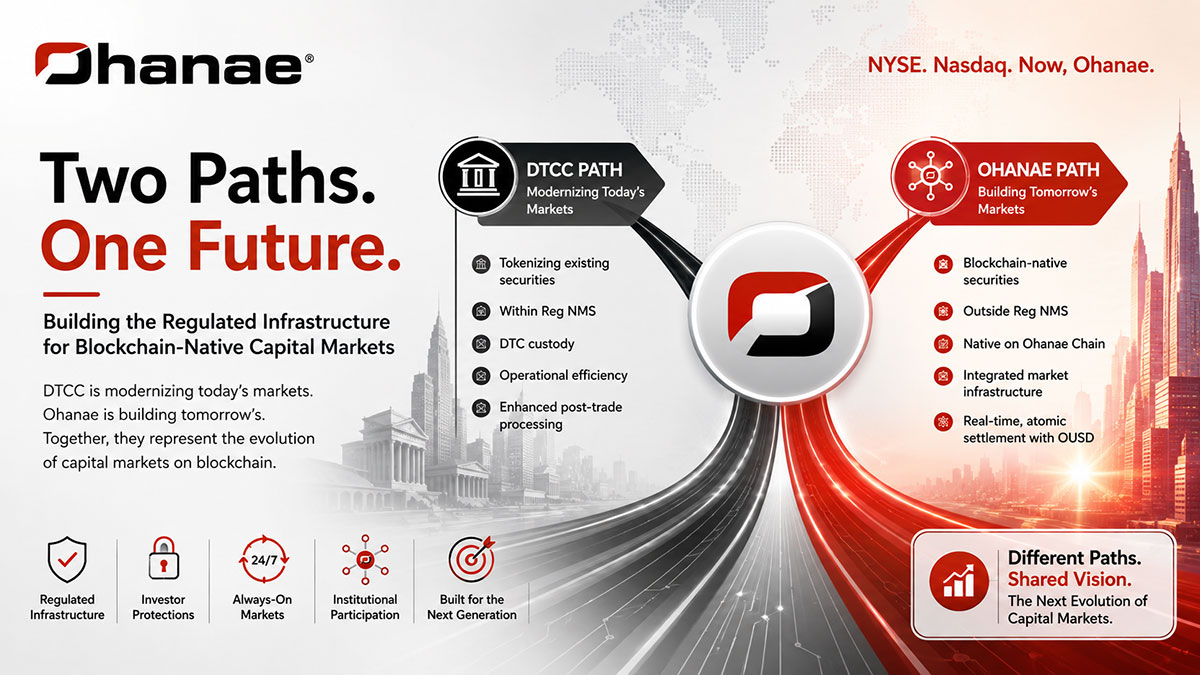
Two Paths to On-Chain Capital Markets: What DTCC's Tokenization Initiative Really Means
For years, the financial industry has debated whether blockchain technology would eventually become part of mainstream capital markets.
That debate is effectively over.
The Depository Trust & Clearing Corporation (DTCC)—the backbone of U.S. securities clearing and settlement—has announced a major milestone in its tokenization initiative, working alongside BlackRock, Goldman Sachs, JPMorgan, Citadel Securities, Nasdaq, NYSE, Circle, Ondo Finance, and numerous other leading financial institutions.
Rather than asking whether securities will move on-chain, the industry is now asking how they will move on-chain.
The answer is becoming increasingly clear.
There are two complementary paths emerging.
Path One: Modernizing Today's Capital Markets
DTCC's initiative represents the evolution of today's financial infrastructure.
Its Tokenization Service creates blockchain-based representations—or "digital twins"—of securities that are already held within the existing Depository Trust Company (DTC) custody system.
These include:
- Russell 1000 equities
- Major index ETFs
- U.S. Treasury securities
Importantly, these securities remain inside the existing U.S. National Market System (Reg NMS).
The blockchain token is not a new security.
Instead, it represents the same underlying security while enabling more efficient post-trade processing.
Potential benefits include:
- Faster settlement workflows
- Improved collateral mobility
- Programmable asset servicing
- Securities financing transactions
- Interoperability across blockchain networks
- Greater operational efficiency
This represents an important modernization of today's market infrastructure.
Path Two: Building Tomorrow's Capital Markets
A second path is also emerging.
Rather than placing existing securities onto blockchain rails, entirely new securities can be issued natively on blockchain.
These securities are designed from inception to operate within a blockchain-native market architecture.
This requires infrastructure specifically designed for:
- Digital issuance
- Custody
- Trading
- Settlement
- Transfer agency
- Dealer-principal liquidity
- Real-time atomic settlement
Instead of adapting legacy infrastructure, blockchain becomes the primary operating environment.
This is a fundamentally different market model.
Two Different Problems. Two Different Solutions.
It is tempting to view these approaches as competing.
They are not.
Each solves a different problem.
DTCC is modernizing the infrastructure that supports today's public securities markets.
Blockchain-native market infrastructure enables securities that are designed to originate, trade, settle, and remain on-chain throughout their lifecycle.
Both approaches are likely to coexist.
One extends today's capital markets.
The other enables entirely new markets.
Why This Matters
The significance of DTCC's announcement extends well beyond the technology itself.
The participation of BlackRock, Goldman Sachs, JPMorgan, Citadel Securities, Nasdaq, NYSE, Circle, Ondo Finance, and other leading financial institutions demonstrates that blockchain has moved beyond experimentation.
The industry's largest participants are now investing in regulated blockchain infrastructure.
The discussion is no longer about whether blockchain belongs in capital markets.
It is about which market architecture will define the next generation of regulated securities markets.
The Opportunity Ahead
As regulatory clarity continues to improve through the SEC's Regulation Crypto rulemaking and Congressional market structure initiatives, the opportunity extends well beyond tokenizing existing securities.
Blockchain-native securities will require purpose-built infrastructure capable of supporting:
- Native digital ownership
- Compliant issuance
- Regulated custody
- Integrated trading
- Real-time settlement
- Programmable corporate actions
- Blockchain-native transfer agency
This represents a new category of regulated market infrastructure rather than simply an extension of existing systems.
Looking Beyond Tokenization
Tokenization is often discussed as though it represents a single destination.
In reality, it represents multiple architectural approaches.
One approach improves the efficiency of today's markets.
The other enables entirely new blockchain-native securities markets.
Both are important.
Both are likely to coexist.
Together, they represent the next evolution of global capital markets.
Where Ohanae Fits
At Ohanae, we believe blockchain-native securities deserve infrastructure purpose-built for their unique characteristics rather than being constrained by legacy market architecture.
While firms such as DTCC are modernizing the infrastructure supporting existing public securities, Ohanae is building the regulated infrastructure for blockchain-native securities markets operating outside the traditional National Market System (Reg NMS).
Our platform is designed to support:
- Issuer-sponsored blockchain-native securities
- Investment Contract Assets (ICA) under future SEC Regulation Crypto
- Regulation A issuers
- S-1 issuers
- F-1 issuers
- Selected OTC-listed securities
- Future blockchain-native capital formation models
We believe these two approaches are complementary.
The future of capital markets will require both modernized legacy infrastructure and purpose-built blockchain-native market infrastructure.
Conclusion
For years, the conversation centered on whether securities would move on-chain.
DTCC's initiative suggests that question has now been answered.
The more important question is what kind of market infrastructure will support the next generation of regulated securities.
The future is unlikely to be defined by a single architecture.
Instead, it will be built upon two complementary paths:
Modernizing today's capital markets through tokenization.
Building tomorrow's blockchain-native capital markets from the ground up.
At Ohanae, we believe the future of capital markets will not simply be tokenized—it will be blockchain-native, combining regulated issuance, trading, custody, settlement, and transfer agency within a purpose-built market infrastructure.
NYSE. Nasdaq. Now, Ohanae.