
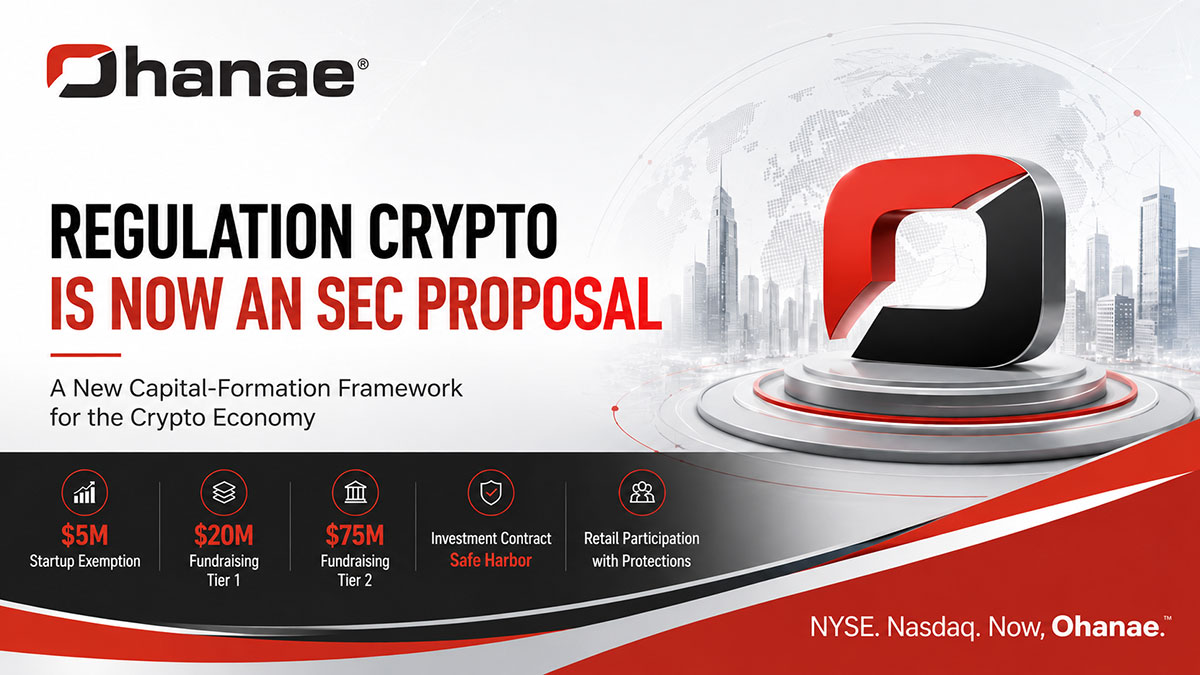
Regulation Crypto Is Now an SEC Proposal: A New Capital-Formation Framework for the Crypto Economy
On August 18, 2026, the U.S. Securities and Exchange Commission formally proposed Regulation Crypto Assets, a new regulatory framework designed specifically for certain investment contracts involving crypto assets.
This represents an important transition in U.S. digital-asset policy.
The discussion has moved from whether the SEC might create a dedicated crypto capital-formation framework to the specific architecture of that framework.
The proposal would establish a $5 million Startup Exemption, a separate Fundraising Exemption with $20 million and $75 million tiers, tailored disclosure requirements, provisions addressing secondary-market transactions and an Investment Contract Safe Harbor that could provide a pathway for a crypto asset eventually to cease being subject to the investment contract with which it was originally associated.
Taken together, these provisions begin to establish something potentially much more consequential than another crypto rule:
a dedicated capital-formation architecture for blockchain-native assets.
From Regulatory Concept to SEC Proposal
The SEC issued Regulation Crypto Assets on August 18 as Release Nos. 33-11434 and 34-106150, File No. S7-2026-27
That distinction matters.
Regulation Crypto is no longer simply a policy concept, an anticipated rulemaking initiative or an item awaiting Commission consideration.
It is now an actual SEC proposed regulation.
The proposal remains subject to public comment, revision and final Commission action. Its provisions therefore should not be treated as final rules.
But the direction is now considerably clearer.
A New Capital-Formation Ladder
One of the most important features of the proposal is that it does not create a single fundraising exemption.
Instead, it establishes a progression of capital-raising pathways for eligible offerings involving covered investment contracts.
Startup Exemption — Up to $5 Million
Eligible issuers could raise up to $5 million during a period lasting no more than four years.
The exemption is intended to provide early-stage crypto projects with a relatively streamlined pathway to finance development while operating within the federal securities-law framework.
Fundraising Exemption Tier 1 — Up to $20 Million
The proposal would permit eligible issuers to raise up to $20 million during a 12-month period under Tier 1.
Tier 1 would carry lighter financial-statement requirements than Tier 2, including no financial-statement assurance requirement.
Fundraising Exemption Tier 2 — Up to $75 Million
Tier 2 would permit eligible issuers to raise up to $75 million during a 12-month period, accompanied by additional financial-statement, disclosure and ongoing reporting requirements.
The resulting framework can be summarized simply:
Startup → $5M
Fundraising Tier 1 → $20M / 12 months
Fundraising Tier 2 → $75M / 12 months
This is a purpose-built exempt-offering ladder for certain investment contracts involving crypto assets.
The Regulation A+ Connection Is Now Explicit
The $75 million threshold is particularly significant.
In its proposing release, the SEC expressly notes that the proposed $75 million Tier 2 offering limit is the same limit applicable to Regulation A Tier 2.
That makes the comparison between Regulation A+ and Regulation Crypto more than an analytical analogy.
Regulation A+ established an alternative pathway for companies to raise substantial amounts of capital outside a conventional registered public offering. Regulation Crypto would bring elements of that capital-formation architecture into a fundamentally different environment involving crypto assets and blockchain-based networks or applications.
There are meaningful similarities.
Both frameworks contemplate substantial public capital formation below the traditional registered-public-offering model. Both combine investor access with increased disclosure requirements at the higher tier. Both also incorporate investment limitations for certain non-accredited investors.
But Regulation Crypto addresses something Regulation A was not designed to solve:
the relationship among the capital raised, the issuer's continuing managerial efforts, the crypto asset and the development of the underlying network or application.
That could make Regulation Crypto more than another securities exemption.
It could become a bridge between entrepreneurial capital formation and blockchain-native economic networks.
Retail Participation Is Part of the Framework
The proposed Fundraising Exemption is not limited solely to accredited investors.
Non-accredited investors generally could participate subject to investment limits tied to income or net worth, with corresponding provisions for non-natural persons.
This matters because broad distribution can play a different role in blockchain networks than it does in conventional venture financing.
Traditional private-company ownership can remain concentrated among founders, venture funds and other sophisticated investors for many years. Blockchain networks, by contrast, may benefit from broader communities of holders, participants and users.
Regulation Crypto appears to recognize that distinction while retaining investor-protection mechanisms.
The Investment Contract Safe Harbor Could Be the Most Important Innovation
Perhaps the most conceptually significant component of Regulation Crypto is the proposed Investment Contract Safe Harbor.
The proposal contemplates circumstances in which an investment contract associated with a crypto asset could be deemed to have ceased to exist after specified conditions have been satisfied.
Among other requirements, an issuer generally would need to have completed—or permanently ceased—the essential managerial efforts it represented or promised to undertake and refrain from making new promises to undertake additional essential managerial efforts.
The issuer would file a transition report explaining the basis for its determination.
If the conditions of the safe harbor are satisfied, the associated crypto asset would no longer be treated as being subject to that investment contract for purposes of the relevant definitions of a security.
That introduces an important regulatory concept:
Capital formation and the subsequent economic life of a crypto asset do not necessarily have to remain legally inseparable forever.
A project could potentially begin with an investment contract subject to securities regulation, use the capital to develop a network or application and ultimately reach a point at which the conditions for transition have been satisfied.
Conceptually, that creates a potential lifecycle:
Capital Formation → Development → Network/Application Functionality → Transition → Independent Crypto Asset
Not every project will necessarily reach that outcome, and eligibility would depend upon the particular facts and compliance with the final regulatory requirements.
But establishing an explicit pathway for that transition is itself significant.
Capital Formation Requires Secondary-Market Infrastructure
Successful capital formation does not end when an offering closes.
Investors need infrastructure for ownership, custody, transfer, trading, liquidity, clearing and settlement.
Regulation Crypto addresses this broader lifecycle in several ways, including proposed federal preemption of certain state securities-law registration and qualification requirements applicable to covered transactions.
The SEC's economic analysis specifically considers whether preemption could reduce duplicative requirements, lower costs and uncertainty, facilitate transactions across state lines and enhance secondary-market liquidity.
This suggests that Regulation Crypto should not be viewed solely as an issuance regulation.
It begins to address how a blockchain-native capital market could operate after the original capital raise.
Why Regulation Crypto Matters for Ohanae
Ohanae has been built around a straightforward thesis:
Blockchain technology can support an integrated, regulated capital market—not merely digital representations of securities layered on top of legacy market infrastructure.
Our FINRA-member subsidiary, Ohanae Securities LLC, has received authorization to expand its business activities to include the custody, clearing, settlement and carrying of crypto asset securities.
Together with Ohanae's broader capital-markets infrastructure, we have been building capabilities intended to support the lifecycle of blockchain-native securities: capital formation, ownership, custody, transfer, trading, liquidity, clearing and settlement.
Regulation Crypto could materially expand the universe of assets and issuers for which infrastructure of this kind becomes relevant.
The emerging architecture is straightforward:
Regulation Crypto creates new potential capital-formation pathways.
Issuers can use blockchain-native investment contracts and crypto assets to raise capital within a regulated framework.
Investors require regulated access, custody and investor protections.
Secondary markets require trading, liquidity, clearing and settlement infrastructure.
Ohanae is building regulated infrastructure intended to connect these components.
This is why we view Regulation Crypto as more than a crypto-policy development.
It is potentially a capital-markets development.
Regulation Crypto remains a proposal, and its ultimate impact will depend on the final rules, regulatory interpretation, market adoption and execution across the industry. But the direction of travel is increasingly clear.
Regulation Crypto and Congressional Legislation
The SEC's proposal is also developing alongside congressional efforts to establish a broader statutory framework for digital assets.
The two approaches can be complementary.
Agency rulemaking can establish regulatory pathways using existing securities laws, while legislation can ultimately provide a broader and potentially more durable statutory foundation.
Regulation Crypto therefore can be understood as an important capital-formation initiative within the larger evolution of U.S. digital-asset regulation.
What Happens Next
The SEC has opened Regulation Crypto Assets for public comment.
The comment period will remain open for 60 days following publication of the proposal in the Federal Register.
The regulatory process therefore moves through several additional stages:
Federal Register Publication → Public Comment → SEC Review → Potential Revisions → Final Rule Consideration
The final regulation may differ materially from the proposal.
But August 18, 2026 marks an important milestone.
From Crypto Regulation to Capital-Market Architecture
For years, much of the U.S. crypto debate has centered on a threshold question:
Is a particular crypto asset a security?
Regulation Crypto begins addressing a different—and potentially more economically important—question:
How should entrepreneurs lawfully raise capital through crypto-asset-related investment contracts, and how should those assets evolve afterward?
The SEC's proposed answer includes a $5 million startup pathway, $20 million and $75 million fundraising tiers, tailored disclosures, retail participation subject to investor protections, secondary-market provisions and a mechanism through which an investment contract may eventually cease to exist.
That begins to look less like a narrow crypto exemption and more like the foundations of a new capital-formation architecture.
For Ohanae, Regulation Crypto reinforces the rationale for building regulated infrastructure capable of supporting the full lifecycle of blockchain-native securities and investment contracts.
NYSE. Nasdaq. Now, Ohanae.
Primary Sources
U.S. Securities and Exchange Commission — Regulation Crypto Assets
Release Nos. 33-11434 and 34-106150
File No. S7-2026-27
August 18, 2026
SEC — Regulation Crypto Assets Proposing Release
Release No. 33-11434
SEC Commissioner Hester M. Peirce — “Filling the Regulatory Tank: Regulation Crypto Assets Proposing Release”
August 18, 2026
This article is provided for informational purposes only and does not constitute legal or investment advice, an offer to sell securities or a solicitation of an offer to purchase securities. Regulation Crypto Assets is a proposed SEC regulation and remains subject to public comment, revision and final Commission action. References to potential market developments and opportunities are forward-looking and subject to regulatory, commercial, market and execution risks.