
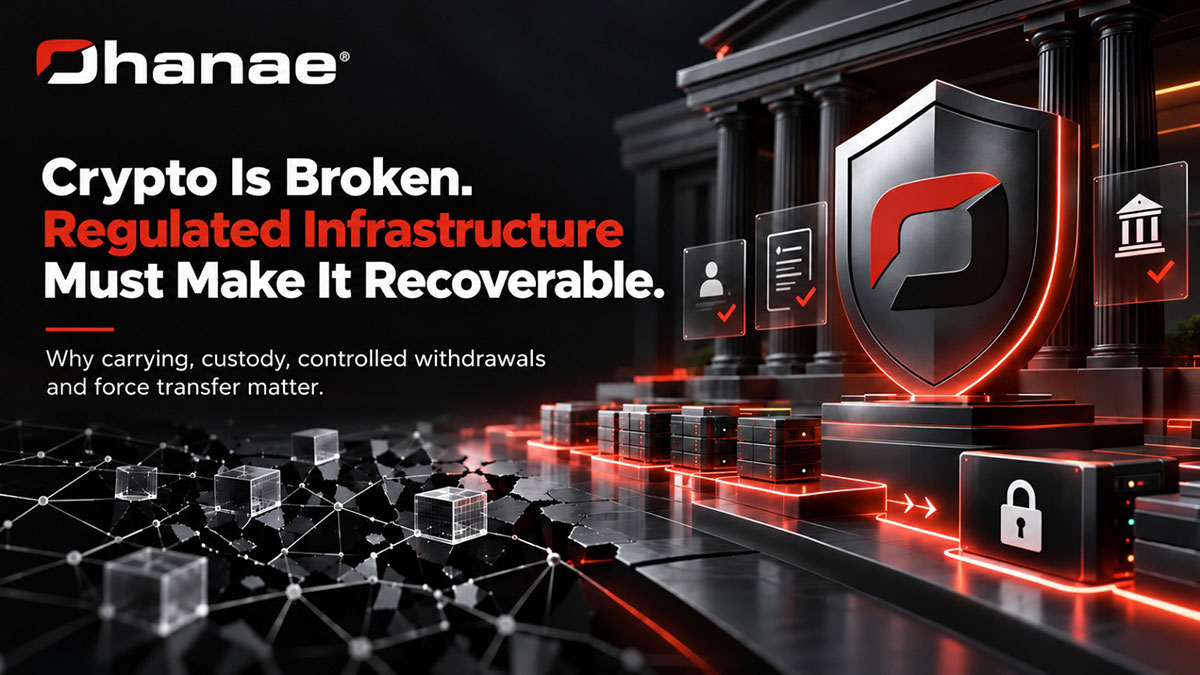
Crypto Is Broken. Regulated Infrastructure Must Make It Recoverable.
Why regulatory compliance, integrated custody, bank-held cash and governed recovery create defense in depth.
A blockchain transaction can be valid—and still be theft.
That is the lesson from the recent Binance incident. CoinDesk reported on October 30, 2026, that an attacker used Ethereum wallet-delegation permissions to drain about $2.5 billion from one Binance wallet, within a wider reported $6.3 billion loss across several networks. Investigators were still examining how the attacker obtained the valid authorizations. The figures and account of events are reported findings, not a final forensic determination.
On October 31, 2026, the FBI attributed the theft of more than $6 billion from Binance to North Korean cyber actors it calls TraderTraitor. The New York Times also reported the FBI’s findings and placed the attack in the context of earlier North Korean cryptocurrency thefts. This raises a basic question: should a compromised digital signature be enough to move billions of dollars beyond recovery? In regulated securities markets, strong custody, independent approvals, controlled withdrawals and properly governed recovery procedures should work together to limit the damage. The FBI’s attribution does not yet resolve every technical detail of the attack.
The broader lesson is simple: a valid digital signature proves that a key authorized an instruction. It does not prove that the rightful asset owner intended it. For securities markets, protection must extend beyond blockchain technology to the institutions responsible for customer assets.
Why stronger wallets are not enough
Ethereum’s EIP-7702 lets a wallet authorize smart-contract code to act on its behalf. This can make wallets more useful, but dangerous permissions can also be abused. In the reported Binance incident, the attacker had multiple valid authorizations to activate malicious wallet behavior. The problem was not just a blockchain feature; it was how authority was obtained and exercised.
Financial institutions need controls that check the real-world authority behind an instruction—not only its cryptographic signature.
Carrying and custody must work together
In a regulated securities market, the customer account, ownership record, securities custody and cash must agree. An unexpected movement of a token should not automatically cause the underlying stock to leave custody. Likewise, moving a digital settlement record should not automatically release bank cash.
A carrying broker-dealer links these controls through customer records, custody procedures, account restrictions, clearing and settlement reconciliation. This creates multiple opportunities to detect and stop a suspicious instruction. The value is not a single feature; it is the way separate controls work together.
Regulatory compliance is part of the security architecture
It is possible to build a restricted token, a multisignature wallet or a force-transfer function without operating a regulated securities firm. Those features are useful, but they do not by themselves create customer-protection obligations, supervisory accountability or a complete custody and settlement process.
Ohanae takes a different approach. Ohanae Securities LLC is a FINRA-member carrying and self-clearing broker-dealer authorized for specified custody, clearing, settlement and carrying activities involving eligible crypto asset securities. That regulatory framework brings obligations for customer protection, records, supervision and controls. The technology is designed to operate within those responsibilities—not outside them.
FINRA authorization does not mean every OUSD feature, smart contract, transfer control or future TSV activity has been separately approved. The safeguards must still be properly implemented, independently tested and supervised.
OUSD: bank-held cash adds a separate line of defense
OUSD illustrates defense in depth. It is an internal digital settlement record used in Ohanae’s ecosystem, not a freely withdrawable cryptocurrency. The supporting customer dollars remain in the traditional banking system under applicable customer-protection arrangements. OUSD cannot be sent off the platform, and moving OUSD does not itself instruct a bank to send money.
To withdraw cash, Ohanae’s described process requires a FINOP to approve each wire individually and send funds only to a whitelisted bank account. That creates a separate payment boundary: a compromised blockchain instruction should not automatically release actual dollars. For this to work, bank-account changes, the exact amount and destination, and final payment instructions must be independently controlled. A compromised application must not be able to bypass the approval.
Why governed force transfer matters
For securities, an unauthorized token transfer should not always be treated as the final word on lawful ownership. A force-transfer function can let authorized officials correct a token record after fraud, error or a legally supported recovery event.
Ohanae describes its equity tokens and OUSD as having this capability, with approval required from two authorized officials. Such powers must be transparent, limited, logged and subject to genuinely independent approvals. The token contract—not the mere fact that Ohanae minted the token—must actually support the recovery operation.
Recovery has limits
Force transfer is not an undo button for everything. It cannot automatically reverse a completed bank wire, recover securities already released by an external custodian, or erase trading losses. Prevention, separation of assets, timely detection and recovery procedures must work together.
Compensation is not the same as protection
After major crypto hacks, exchanges have sometimes reimbursed customers using their own funds, dedicated reserves or new financing. Bybit, Bitfinex and Coincheck are examples of different ways firms have addressed losses. Reimbursement can help customers, but it does not mean the stolen assets were recovered or that the theft could not happen again.
Ohanae’s approach begins earlier. Its regulated carrying and custody framework, restricted token transfers, bank-held customer cash, individually approved withdrawals and governed force-transfer controls are designed to stop a single compromised blockchain instruction from automatically becoming a loss of underlying securities or bank cash.
Compensation remains an important last resort when prevention fails. The objective of defense in depth is to reduce the chance and size of a loss first—and maintain lawful recovery options if an incident still occurs. No regulatory license or technical control guarantees that customers can never lose money.
The Ohanae approach
- Restrict peer-to-peer transfers of equity tokens and OUSD.
- Keep underlying tokenized public shares under appropriate securities-custody arrangements.
- Maintain bank-held cash with individually approved withdrawals to whitelisted accounts.
- Require two authorized officials for force transfer and keep a complete audit trail.
- Reconcile customer accounts, custody records, token supply and any lawful corrections.
Together, these measures create defense in depth. A token-level failure should not automatically become a bank-cash withdrawal or release of underlying securities; governed correction may address unauthorized token movements. This separation is a design objective, not a guarantee. Its effectiveness depends on secure implementation, genuinely independent approvals, regular reconciliation, testing and operational discipline. Neither regulatory status nor a permissioned blockchain makes a system immune from attack.
A financial system needs a path to recovery
Blockchain can improve records and settlement, but speed and automation are not substitutes for accountability. Ohanae’s point is not that it alone invented these technologies. It is that carrying, custody, cash protection, controlled withdrawals and recovery can be integrated under a regulated operating framework. Technology enables settlement. Regulatory compliance creates accountability. Defense in depth helps protect the customer.
Confidence. That’s Ohanae.
Further reading
CoinDesk, October 30, 2026: “Here’s how an Ethereum upgrade helped drain part of Binance’s $6 billion loss.”
FBI, October 31, 2026: “North Korea Responsible for $6 Billion+ Binance Attack.”
The New York Times, October 31, 2026: “North Korean Hackers Stole Billions, the F.B.I. Says. It’s Not Their First Heist.”
Educational commentary. The October 31 FBI attribution is an investigative finding; technical details may change. Ohanae controls are based on its stated operating design, not an independent security assessment. FINRA authorization does not certify individual OUSD functions or the proposed TSV. No system eliminates all cyber, operational or fraud risk.