
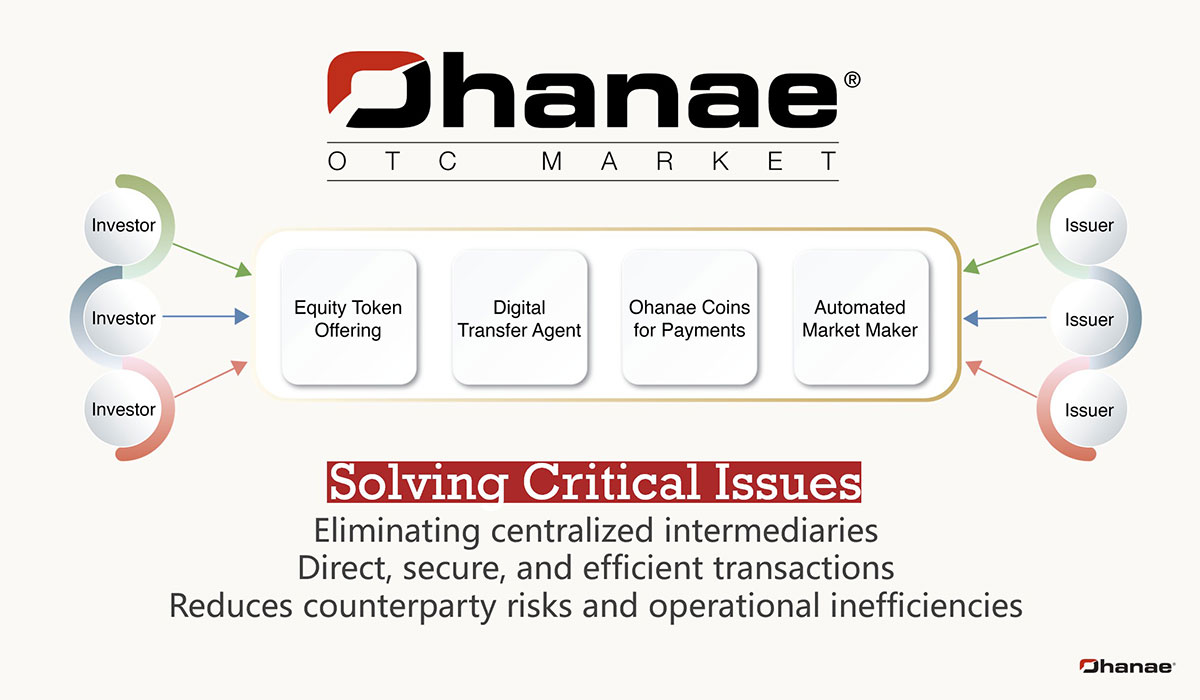
The Future of Non-Stop Liquidity Made Simple
Abstract
Traditional Alternative Trading Systems (ATS) face significant regulatory and operational constraints—they cannot act as custodians, trade as dealers in a principal capacity, or provide seamless liquidity solutions. Additionally, traditional ATS platforms lack atomic settlement capabilities, leading to delayed and risk-prone transactions. The emergence of hybrid Automated Market Maker (AMM) settlement models presents a groundbreaking alternative for trading crypto asset securities in a non-Reg NMS OTC Market. Ohanae's Web3-powered platform leverages tokenization, real-time settlement, atomic settlement, and AMM-based liquidity provisioning to create a compliant, efficient, and transparent trading environment. This paper explores the limitations of traditional ATS models and how Ohanae’s innovative approach addresses them through a vision for the future of digital securities markets.
Introduction
The evolution of digital securities markets is being shaped by tokenization and decentralized finance (DeFi) principles. Traditional ATS platforms, constrained by regulatory requirements, struggle to provide efficient settlement and liquidity solutions for crypto asset securities. These limitations hinder market efficiency and increase reliance on intermediaries. Ohanae introduces a novel approach—leveraging a hybrid AMM settlement model for crypto asset securities. This model envisions principal trading, real-time settlement, atomic settlement, and enhanced market efficiency.
What Are Crypto Asset Securities?
Crypto asset securities are digital representations of traditional securities, such as equities or debt instruments, that are issued and traded on blockchain-based platforms. Unlike purely speculative cryptocurrencies, crypto asset securities are subject to U.S. securities laws and regulations, providing investors with legally recognized ownership rights. These securities leverage blockchain technology to enhance transparency, reduce settlement times, and eliminate intermediaries, making them a more efficient alternative to traditional financial instruments.
Understanding Non-Reg NMS OTC Markets
The National Market System (NMS) governs the trading of listed securities on national exchanges, enforcing rules such as best execution and trade-through protections. However, Non-Reg NMS OTC Markets operate outside these regulations, primarily facilitating the trading of unlisted securities, including crypto asset securities. This structure offers greater flexibility but also requires a robust framework to ensure market integrity and investor protection. The Ohanae platform is designed to operate within this non-Reg NMS OTC structure, leveraging AMM technology to provide liquidity while maintaining compliance with regulatory requirements.
What is an Automated Market Maker (AMM)?
An Automated Market Maker (AMM) is a decentralized trading mechanism that allows users to trade assets without relying on traditional order books or human market makers. Instead, AMMs use algorithmically determined liquidity pools to facilitate trades, enabling continuous liquidity and price adjustments based on supply and demand.
How AMMs Work:
- Liquidity Pools: Rather than matching buyers and sellers, AMMs use liquidity pools funded by liquidity providers (LPs). These pools ensure that assets are always available for trading.
- Pricing Algorithm: AMMs use a mathematical formula (such as the constant product formula, x * y = k) to determine asset prices based on the ratio of assets in the liquidity pool.
- Decentralized and Automated: Unlike traditional market makers that require active trading and manual price setting, AMMs execute trades programmatically on the Ohanae blockchain, reducing inefficiencies.
AMMs are widely used in DeFi markets and are now being adapted for regulated securities markets, like Ohanae's hybrid AMM model, to ensure continuous liquidity and efficiency.
The Role of a Blockchain-Based Digital Transfer Agent
A key component of Ohanae's infrastructure is its blockchain-based digital transfer agent, which facilitates the issuance, recording, and transfer of tokenized securities in a fully automated and transparent manner. Traditional transfer agents rely on centralized systems, manual processes, and delayed reconciliations, whereas Ohanae's digital transfer agent operates on a permissioned blockchain, ensuring real-time accuracy and compliance.
Key Functions of Ohanae's Digital Transfer Agent:
- Real-Time Cap Table Management – Every transaction updates the shareholder registry instantly, maintaining a clear and transparent record of ownership.
- Automated Corporate Actions – Smart contracts execute actions such as dividend distributions, stock splits, and voting rights without the need for manual intervention.
- Immutable Record-Keeping – All securities transactions are recorded on an immutable blockchain ledger, reducing fraud risks and ensuring regulatory compliance.
- Seamless Transfers – The transfer agent enables secure, instant settlement of tokenized securities without relying on traditional clearing and settlement processes.
By integrating a blockchain-based digital transfer agent, Ohanae eliminates the inefficiencies of legacy securities infrastructure, enhancing transparency, security, and compliance.
The Limitations of Traditional ATS
While ATS platforms play a critical role in facilitating trading outside national exchanges, they suffer from inherent constraints:
- No Custody Role – ATS platforms cannot act as custodians, requiring external clearing and settlement mechanisms that introduce delays and counterparty risks.
- No Principal Trading – An ATS is not permitted to trade as a dealer in a principal capacity, limiting its ability to provide liquidity.
- Reliance on Third-Party Liquidity – Traditional ATS platforms depend on external market makers, increasing market fragmentation and inefficiencies.
- Delayed Settlement – The need for external clearing agencies results in T+1 settlement cycles, exposing traders to counterparty risk.
- No Atomic Settlement – Traditional ATS platforms rely on separate clearing and settlement processes, leading to failed trades and settlement risks. Transactions are not executed and settled simultaneously, which introduces credit and counterparty risks.
The Ohanae Hybrid AMM Settlement Model
Ohanae's approach overcomes these limitations by integrating an AMM-driven trading model within a permissioned blockchain framework, ensuring compliance and efficiency. Key elements include:
1. Principal Trading via AMM-Based Liquidity
Ohanae envisions acting as a dealer in principal capacity. The platform's AMM-based model ensures continuous liquidity by dynamically adjusting pricing based on demand and supply, eliminating reliance on third-party market makers.
2. Real-Time and Atomic Settlement with Ohanae Coin (OUSD)
All trades are designed to settle instantly using Ohanae Coin (OUSD), a covered stablecoin pegged 1:1 to the U.S. dollar. This mechanism eliminates counterparty risk and enhances capital efficiency. Additionally, Ohanae enables atomic settlement—a process where transactions are executed and settled simultaneously, ensuring no partial or failed trades. By leveraging atomic settlement, Ohanae eliminates settlement risk and the reliance on clearing agencies.
3. Compliance-Driven Permissioned Blockchain
Unlike public DeFi models, Ohanae operates on a permissioned blockchain that enforces KYC/AML verification for all participants, ensuring regulatory compliance and security.
Conclusion
The traditional ATS model is ill-equipped to support the evolving landscape of crypto asset securities. Ohanae’s hybrid AMM settlement model, powered by a permissioned blockchain and real-time atomic settlement via OUSD, provides a scalable and compliant alternative. By integrating principal trading, automated liquidity provisioning, atomic settlement, and a blockchain-based digital transfer agent, Ohanae is redefining digital capital markets and paving the way for a more efficient and transparent trading ecosystem.
Disclaimer
Ohanae Securities LLC is a subsidiary of Ohanae, Inc. and a member of the Financial Industry Regulatory Authority and Securities Investor Protection Corporation (FINRA/SIPC). Additional information about Ohanae Securities LLC is available on BrokerCheck.
Ohanae Securities LLC is currently in discussions with FINRA regarding the potential expansion of its business lines, which may include custody and related services for crypto asset securities. Any statements regarding the capabilities or services of Ohanae Securities LLC are subject to regulatory approval, and there can be no assurance that such approvals will be obtained.
Ohanae Securities LLC intends to operate in a manner that addresses the unique characteristics of crypto asset securities, including maintaining robust policies and procedures for custody, safeguarding of private keys, and evaluation of distributed ledger technology. The firm’s approach is designed to support crypto asset securities that may not efficiently operate within the traditional National Market System (NMS). Subject to applicable regulatory approvals, Ohanae Securities LLC may expand its activities to include additional services that may be conducted in a dealer-principal capacity, with the objective of protecting investors and maintaining market integrity.