
Built Within a Regulated Broker-Dealer Framework
This is built within a regulated broker-dealer framework—extending custody of crypto asset securities into an integrated architecture designed to enable trading and real-time settlement within a unified system.
How the Market Starts
Ohanae does not require the entire market to move at once.
We begin with:
- New issuers and selected companies where 24x7 trading and global access provide immediate advantages
- Broker-dealer syndicates bringing supply directly onto the platform
- Institutional liquidity providers contributing inventory under dealer-principal capacity
This creates:
- Immediate tradable assets
- Controlled liquidity from day one
- A foundation for continuous market formation
From there, liquidity compounds—and market migration follows.
Regulatory Unlock for a New Market Structure
Ohanae is being structured within a FINRA-regulated broker-dealer framework designed to integrate issuance, trading, custody, and real-time settlement of tokenized securities through an integrated, on-chain market infrastructure.
The architecture combines broker-dealer operations, custody of crypto asset securities, digital transfer agency, and atomic settlement into a unified system designed for continuous markets.
Earlier regulatory frameworks for digital asset securities were primarily focused on custody.
What is evolving now is regulatory engagement around integrating trading, settlement, and ownership records within coordinated, compliant market infrastructure.
Ohanae is built for that shift.
Special Blog
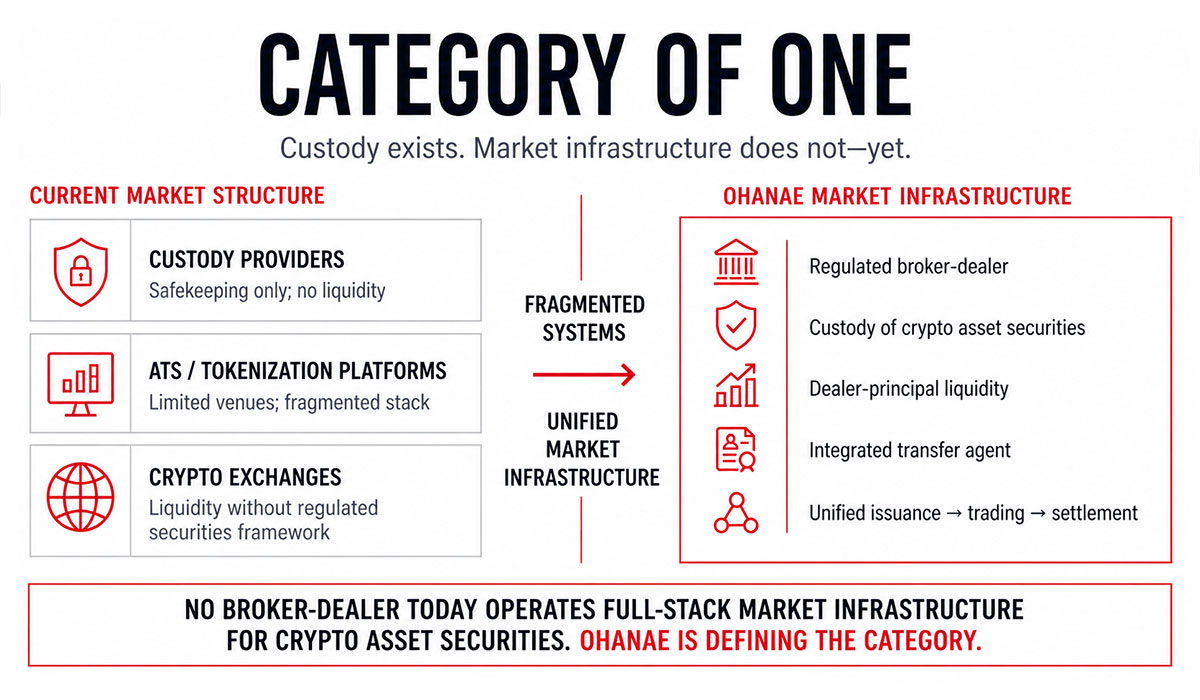
Custody exists. Market infrastructure does not—yet.
With approval to custody crypto asset securities, Ohanae Securities LLC, a wholly owned subsidiary of Ohanae, Inc., now operates within the core broker-dealer framework—marking a shift from experimental models to institutional market infrastructure.
In this context, “Ohanae” refers to the market infrastructure itself—a regulated, integrated system for the issuance, trading, and settlement of crypto asset securities.
NYSE. Nasdaq. Now, Ohanae.
For years, the digital asset industry has focused on one idea: tokenization.
Tokenized equities. Tokenized funds. Tokenized real-world assets.
But tokenization alone does not create markets.
It changes the format of assets—without addressing how those assets are issued, traded, settled, and owned at scale.
That leaves a more fundamental question unanswered:
Where—and how—do these assets actually trade?
Because today, the answer is fragmented.
Custody sits in one place.
Trading sits in another.
Settlement remains constrained by legacy systems.
What’s missing isn’t more tokens.
It’s the infrastructure that allows markets to function as integrated systems.
And that’s the gap the industry has yet to solve—until now.
The Industry Solved the Wrong Problem
Today’s market is fragmented.
- Custody providers focus on safekeeping assets—but offer no liquidity
- ATS and tokenization platforms enable issuance and limited trading—but rely on disconnected systems
- Crypto exchanges provide liquidity—but operate outside the regulated securities framework
Each solves a piece of the puzzle—but none delivers a functioning market system.
None solves the system.
What’s missing isn’t more tokens.
It’s market infrastructure.
Tokenization Without Market Structure Doesn’t Scale
Tokenization has been treated as the breakthrough. In reality, it’s just a format change.
Without integrated infrastructure:
- Liquidity remains fragmented
- Settlement remains inefficient
- Ownership records remain disconnected
- Markets remain constrained by legacy structures
Tokenization without market structure does not scale.
That is the paradox.
Digital securities can be created—but digital markets still lack the infrastructure to operate at scale.
The Regulatory Shift That Changes Everything
For years, innovation in crypto asset securities was confined to experimental regulatory frameworks.
These frameworks have historically been narrow by design:
- Focused primarily on custody
- Limited in scope
- Not built for full market operations
Now, a structural shift is underway.
The path forward is no longer experimental.
It is being integrated into the core broker-dealer system under the Financial Industry Regulatory Authority (FINRA).
This matters.
Because real markets don’t run on sandboxes.
They run on institutional infrastructure.
From Fragmented Systems to Unified Market Infrastructure
What the market lacks today is not innovation—but integration.
A functioning market requires:
- Custody
- Liquidity
- Settlement
- Ownership records
- Capital formation
Not as separate services—but as a unified system.
This is how traditional markets scale.
It’s also what digital markets have been missing.
Defining a New Category
Ohanae is built on a simple premise:
Markets don’t evolve. They get replaced.
Rather than retrofitting legacy systems or layering tokenization on top of fragmented infrastructure, Ohanae is advancing a clean-slate market structure for crypto asset securities.
This includes:
- A regulated broker-dealer foundation
- Integrated custody and private key safeguarding
- Dealer-principal liquidity as part of the platform design
- Unified issuance, trading, and settlement architecture
- Blockchain as the system of record
Not as separate components—but as one system.
Ohanae is defining this category by delivering a unified market infrastructure within a regulated broker-dealer framework.
Category of One
A “Category of One” means there is no direct comparable—no existing market structure that delivers this combination of capabilities within a regulated broker-dealer framework.
No broker-dealer today operates full-stack market infrastructure for crypto asset securities.
That is the gap—and that gap defines the category.
Ohanae is not entering an existing category.
It is defining the category.
The Path Forward
The next phase of digital markets will not be driven by more assets.
It will be driven by better market structure.
The winners won’t be those who tokenize first.
They will be those who control:
- Liquidity
- Settlement
- Market design
That’s where value accrues.
That’s where markets are defined.
Closing
Ohanae has moved from an experimental framework into the core broker-dealer system—scaling real market infrastructure, not just tokenization.
Custody exists. Market infrastructure does not—yet.
Markets don’t evolve. Market structure gets replaced.
Ohanae is building the next generation of market infrastructure.
Confidence. That’s Ohanae.
Additional Resources
Learn more about Ohanae's vision, strategy, and market infrastructure approach.